Hell Creek, the neighbours and the asteroid
T. rex lived on an island continent, in warm, wet country full of flowering plants, duck-billed dinosaurs and Triceratops. Then, 66 million years ago, everything changed.
Laramidia
It lived in what is now western North America, which was then an island continent called Laramidia. Wikipedia: Tyrannosaurus Laramidia was cut off from the east of North America by a shallow inland sea, the Western Interior Seaway. Wikipedia: Western Interior Seaway
Its fossils have been found from Canada in the north to at least New Mexico in the south. Wikipedia: Tyrannosaurus
The Hell Creek Formation
Many T. rex fossils come from the Hell Creek Formation, rocks that stretch across parts of Montana, North Dakota, South Dakota and Wyoming. Wikipedia: Hell Creek Formation The Hell Creek Formation is named after Hell Creek, near Jordan, Montana. Wikipedia: Hell Creek Formation
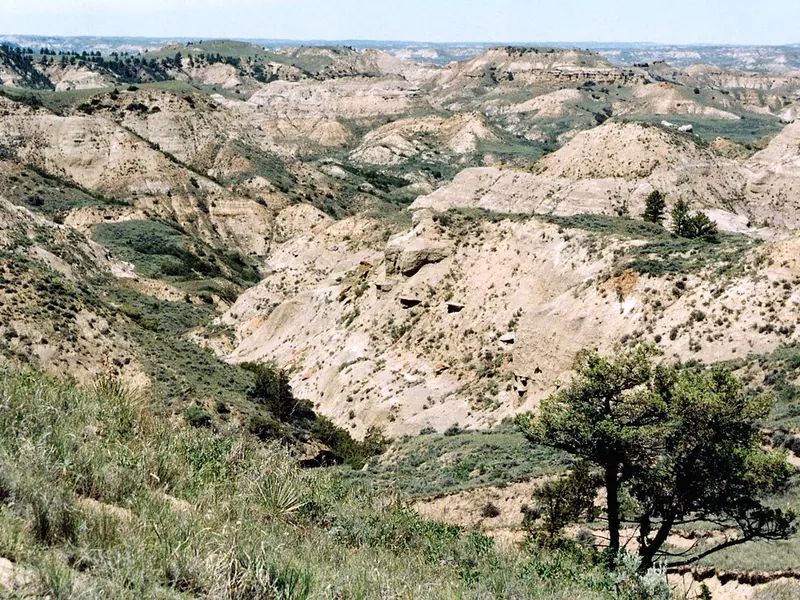
Back then the Hell Creek area was warm and humid. Most plants were flowering plants, with trees such as dawn redwood. Wikipedia: Tyrannosaurus Crocodilians and palm trees found there suggest a mild climate with no long freezes. Wikipedia: Hell Creek Formation
The neighbours
T. rex shared Hell Creek with Triceratops, Edmontosaurus, Ankylosaurus, Pachycephalosaurus and Thescelosaurus, among others. Wikipedia: Tyrannosaurus
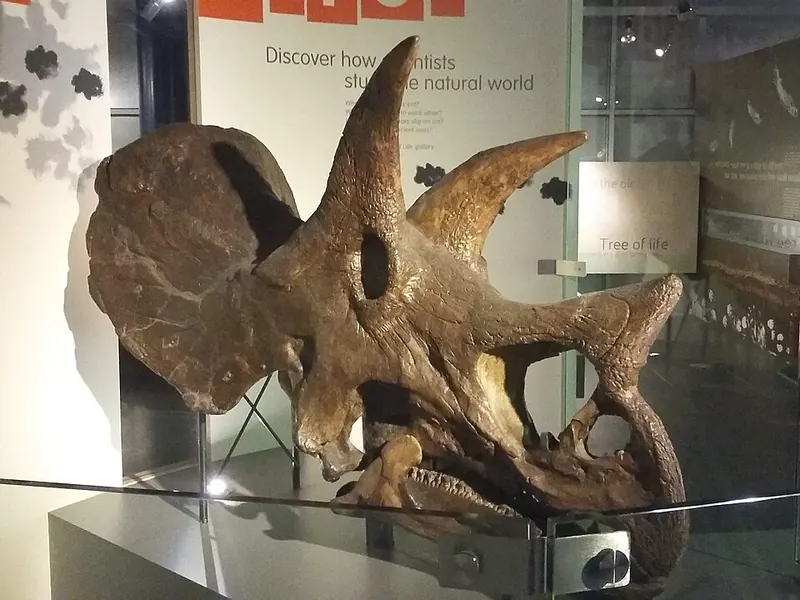
Triceratops
Triceratops, the “three-horned face”, lived at the same time and place and was most likely hunted by T. rex. Wikipedia: Triceratops Triceratops was around 8–9 m long and weighed up to 6–10 tonnes. Wikipedia: Triceratops · checked 24 Oct 2026
Edmontosaurus
Edmontosaurus annectens was a duck-billed dinosaur up to about 12 m long. Wikipedia: Edmontosaurus · checked 24 Oct 2026
Ankylosaurus
Ankylosaurus, an armoured dinosaur, was named by Barnum Brown in 1908. Its name means “fused lizard”. Wikipedia: Ankylosaurus
The family
Tyrannosaurus is the type genus of the tyrannosaur family, Tyrannosauridae: the yardstick used to decide which other dinosaurs belong in the group. Wikipedia: Tyrannosaurus All tyrannosaurids lived near the end of the Cretaceous, and their fossils have been found only in North America and Asia. Wikipedia: Tyrannosauridae
Its closest known relative is probably Tarbosaurus, which lived in Asia. Wikipedia: Tyrannosaurus · checked 24 Oct 2026 A 2016 study suggested Tyrannosaurus may have been an immigrant from Asia. Wikipedia: Tyrannosaurus · checked 24 Oct 2026
Tyrannosaurs started out as small theropods. Some only became large by the Early Cretaceous. Wikipedia: Tyrannosaurus
How many were there?
A 2021 study estimated there were perhaps 20,000 adult T. rex alive at any one time, with a possible range of 1,300 to 328,000. Other scientists have questioned the numbers. Wikipedia: Tyrannosaurus · checked 24 Oct 2026 The same study estimated about 2.5 billion T. rex lived over the whole time the genus existed. Wikipedia: Tyrannosaurus · checked 24 Oct 2026
Footprints
A single large footprint found in New Mexico in 1983, named Tyrannosauripus pillmorei in 1994, was very likely made by a T. rex. It is 83 cm long. Wikipedia: Tyrannosaurus
The end of the Cretaceous
About 66 million years ago a mass extinction wiped out three-quarters of plant and animal species on Earth, including all the non-avian dinosaurs. Wikipedia: Cretaceous–Paleogene extinction event It is generally thought to have been caused by an asteroid 10 to 15 km wide, which made the Chicxulub crater in Mexico. Wikipedia: Cretaceous–Paleogene extinction event
The boundary layer in the rocks has unusually high levels of iridium, a metal more common in asteroids than in Earth’s crust. Wikipedia: Cretaceous–Paleogene extinction event The famous iridium-rich boundary layer can be seen in the Hell Creek Formation. Wikipedia: Hell Creek Formation
The impact caused a long “impact winter” that stopped plants and plankton from photosynthesising. Wikipedia: Cretaceous–Paleogene extinction event
Not quite the end
Birds are the only dinosaur lineage known to have survived. Wikipedia: Dinosaur Birds are the only living dinosaurs. They evolved from earlier theropods, the same big group T. rex belongs to. Wikipedia: Bird
Closer to us than to Stegosaurus
Stegosaurus lived between 155 and 145 million years ago, in the Late Jurassic. Wikipedia: Stegosaurus Its fossils come from rocks dated to the end of the Cretaceous period, 69 to 66 million years ago. Wikipedia: Tyrannosaurus So more time separates Stegosaurus and T. rex than separates T. rex and you. Try sorting more animals in Before, With or After?
Next: myths vs facts →